
Mediation Scripts for Difficult Co-Parenting Conversations
When messages go unanswered, agreements keep changing, or every discussion turns into another argument, knowing what to say can be difficult.
This practical digital bundle gives you adaptable scripts, written-message templates, preparation tools, and printable worksheets for the co-parenting situations that most often disrupt mediation.
- Complete 47-page digital ebook
- Standalone quick-reference script sheets
- Printable mediation worksheets and record-keeping tools
- Read on your phone, tablet, or computer
- Download immediately after purchase
When every conversation feels harder than it should
Co-parenting conversations can become tense even when both parents want what is best for their children.
A simple question about a school expense, holiday schedule, or collection time can quickly turn into silence, blame, interruptions, or another argument about the past.
You may know what you want to communicate but struggle to find language that is calm, clear, and firm without sounding hostile or giving up your position.
Mediation Scripts for Difficult Co-Parenting Conversations was created for those moments.
It does not tell you to ignore genuine disagreements or accept arrangements that do not work for you. It gives you a more deliberate way to express your concerns, redirect unproductive discussions, and propose a practical next step.
What you receive
A three-part digital co-parenting resource bundle
1. The complete 47-page ebook
A structured guide covering difficult communication before, during, and after co-parenting mediation.
Inside, you will find:
- A safety check before using any script
- The Acknowledge–Redirect–Propose method
- Ten common co-parenting conflict situations
- Practical scripts you can adapt
- Guidance for preparing before mediation
- A realistic mediation-session walkthrough
- Language for asking your mediator for support
- Written message and email templates
- Guidance on recognising when scripts are not enough
- Worksheets, logs and quick-reference pages
2. Quick-reference script sheets
Standalone pages containing concise language for situations such as:
- When the other parent stops responding
- When an agreement is later disputed
- When the conversation becomes heated
- When you are interrupted
- When you feel pressured to agree
- When you need a private discussion with the mediator
- When you want agreements confirmed in writing
Save the pages to your phone or print them before your next mediation session.
3. Printable worksheets
Practical tools that help you prepare, organise information and keep clearer records.
The worksheets include:
- Session preparation worksheet
- Issue priority worksheet
- Communication log
- Shared expense log
- Questions to ask before signing an agreement
- Quick-reference script pages
The bundle contents reflect the actual ebook, including its ten co-parenting scenarios, communication framework, written templates, safety guidance and printable tools.
Practical support for ten difficult co-parenting situations
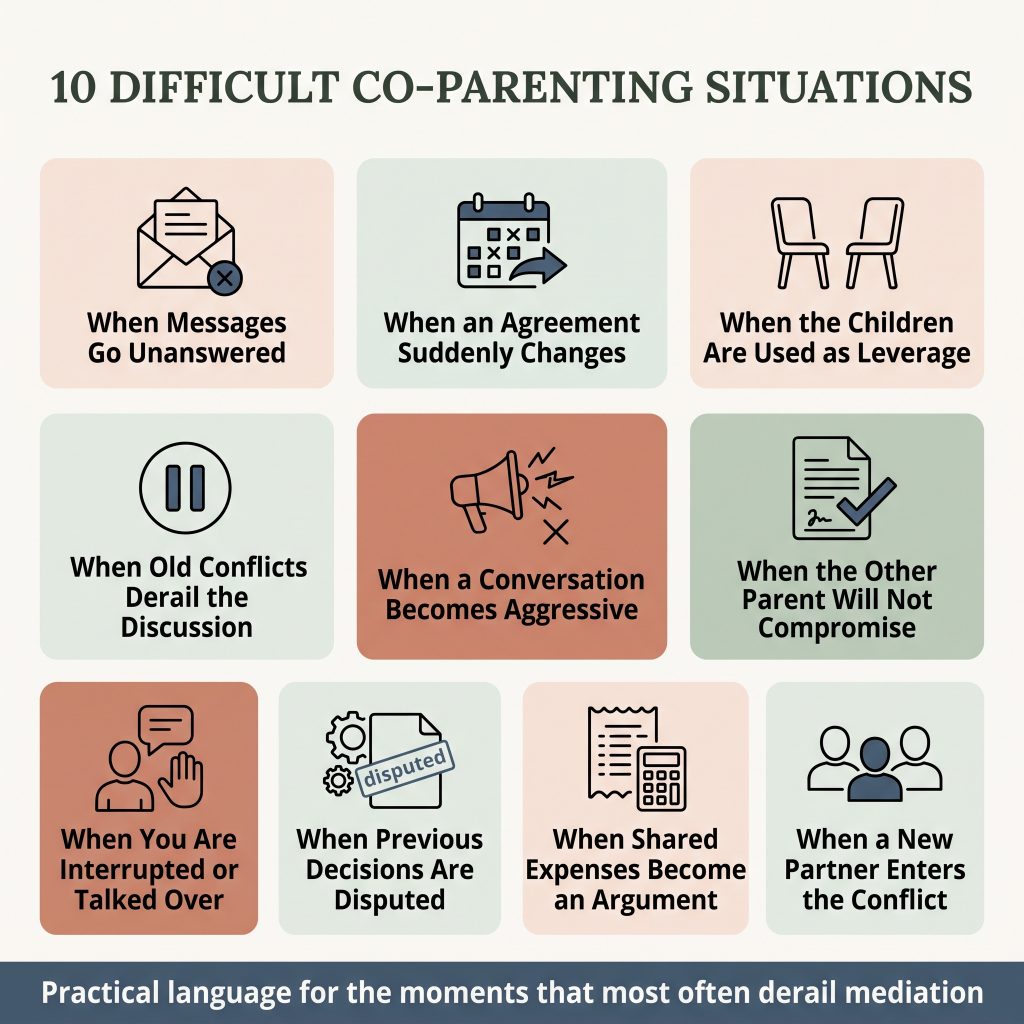
The guide provides adaptable language for moments such as:
When messages go unanswered
Follow up without sending repeated emotional messages or beginning with an accusation.
When an agreement suddenly changes
Clarify what has changed and suggest a process for recording provisional agreements.
When the children are brought into the conflict
Keep the discussion focused on the actual parenting decision without dismissing legitimate concerns about the children.
When old grievances derail the discussion
Acknowledge that the issue exists while returning the conversation to the current agenda.
When the other parent will not compromise
Move beyond fixed positions and ask what underlying concern matters most.
When the conversation becomes aggressive
Slow the discussion down, ask for a break, and involve the mediator when necessary.
When you are interrupted or talked over
Name the behaviour calmly and ask for a clear turn-taking rule.
When previous decisions are disputed
Shift the discussion away from competing memories and towards written records.
When shared expenses become an argument
Focus on one expense at a time and clarify the amount, reason and proposed contribution.
When a new partner enters the conflict
Separate legitimate parenting concerns from arguments about the relationship itself.
A simple structure for difficult conversations
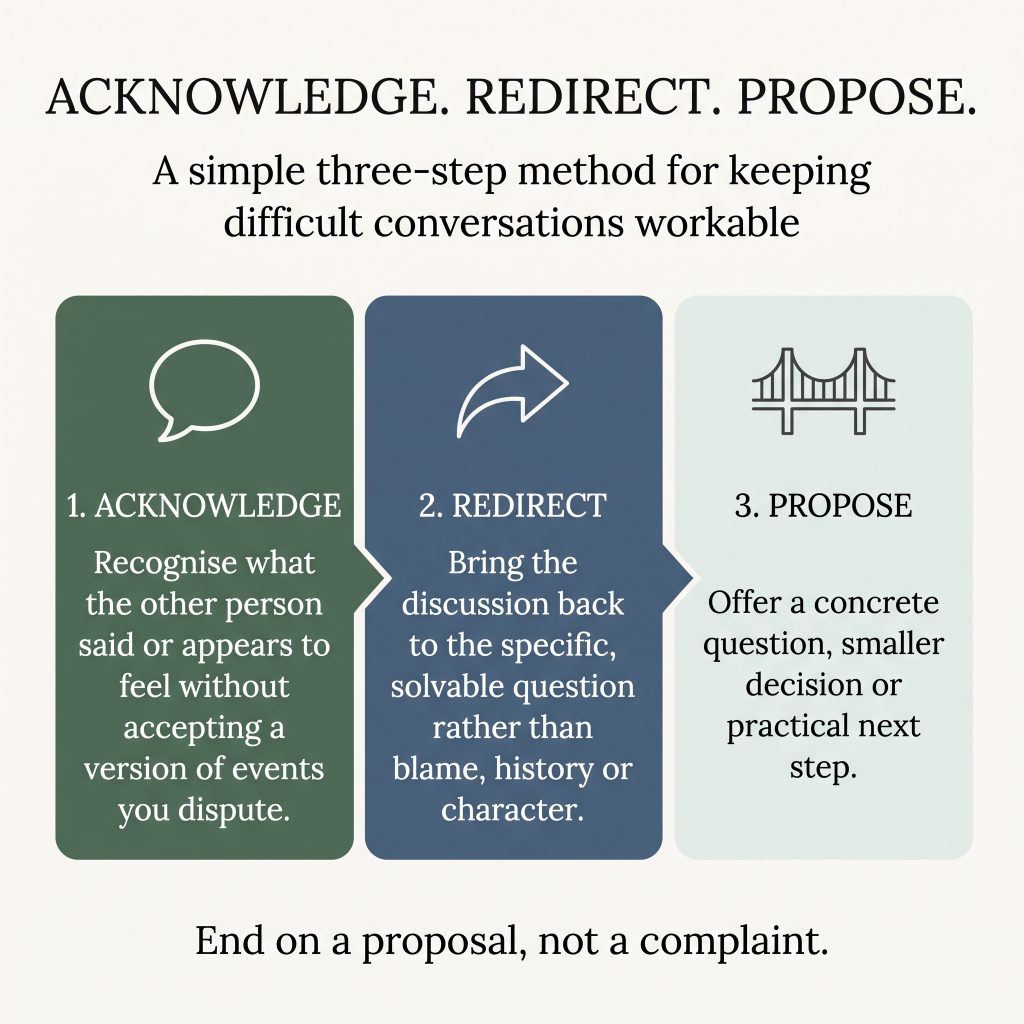
Acknowledge. Redirect. Propose.
Many of the scripts in the guide follow one practical three-step structure.
1. Acknowledge
Recognise what the other parent has said or appears to feel without agreeing to a version of events you do not accept.
Acknowledgment does not mean surrendering your position. It shows that you heard the concern before moving the discussion forward.
2. Redirect
Bring the conversation back to the specific question that needs to be solved.
This helps move the discussion away from blame, past arguments and personal criticism.
3. Propose
End with a concrete next step.
That may be a question, a smaller decision, a trial arrangement, a request for written confirmation or a suggestion for how the mediator can assist.
End on a proposal, not a complaint.
Once you understand this framework, you can adapt it to situations beyond the examples in the ebook.
Real language you can adapt
This is not a book filled only with general communication theory.
It gives you practical wording for actions such as:
- Following up after silence
- Asking for a response by a reasonable date
- Confirming what was agreed during mediation
- Responding when someone changes their position
- Asking for a short break
- Requesting a private caucus with the mediator
- Asking about shuttle or separate-session mediation
- Explaining that you feel pressured
- Requesting reimbursement for a shared expense
- Establishing email or a co-parenting app as the agreed communication channel
The scripts are designed to be adapted. You can change the wording so that it sounds natural to you while preserving the underlying structure.
Prepare before the conversation begins
The right words are easier to use when you have already thought through what matters.
The preparation tools help you identify:
- The specific issue being discussed
- Facts both parents appear to agree on
- Facts that remain disputed
- Your underlying concern
- Your preferred outcome
- Your minimum workable outcome
- Alternatives you could propose
- Documents you need to bring
- The sentence you will use if the conversation stalls
- The point at which you will ask for a break
This turns vague anxiety into a clearer plan for the session.
Keep clearer written records
Disputes often become harder when both parents remember conversations differently.
The included logs help you record factual information such as:
- Dates messages were sent
- The subject being discussed
- Communication method
- Response deadlines
- Whether a response was received
- Shared child-related expenses
- Amounts requested
- Receipts supplied
- Payments made
- Outstanding balances
These tools are intended to help you stay organised. They are not a substitute for professional legal advice about what records may be confidential or admissible in your jurisdiction.
This guide may be suitable for you if…
- You are separated or separating
- You are preparing for co-parenting mediation
- Messages regularly go unanswered
- Agreements are frequently misunderstood or changed
- Discussions become emotional or unfocused
- You struggle to respond when interrupted or pressured
- Shared expenses cause repeated arguments
- You want practical wording instead of vague advice
- You want to prepare more clearly before your next session
- You want a more organised way to track communication and expenses
When this guide is not enough
These scripts are intended for ordinary co-parenting friction.
They are not designed as the main response to situations involving:
- Physical violence
- Credible threats
- Stalking
- Intimidation
- Coercive control
- Financial abuse
- Threats involving the children
- Fear of retaliation
- A serious power imbalance that prevents voluntary participation
Where any of these are present, speak privately with a qualified mediator, family-law professional or appropriate support service before communicating directly with the other parent.
Calm wording cannot make an unsafe situation safe or force someone to participate in good faith.
About Caroline Diana Njama
Family Mediation Practitioner and Conflict Resolution Practitioner
Caroline Diana Njama helps families navigate difficult conversations, find common ground and work towards peaceful, practical solutions through professional and confidential mediation.
Her practice covers:
- Divorce and separation mediation
- Child custody and parenting plans
- Co-parenting communication
- Family relationship conflicts
- Inheritance and estate disputes
- Communication and conflict resolution
Her role is not to take sides or make decisions for a family. It is to guide conversations in which each person has an opportunity to be heard and practical options can be explored.
Website: carolinediananjama.com
Email: info@carolinediananjama.com
Frequently asked questions
What exactly will I receive?
You will receive three digital resources:
- The complete 47-page ebook
- The standalone quick-reference script PDF
- The standalone printable worksheets PDF
Is this a physical book?
No. This is a digital product. You can read it on a phone, tablet or computer and print selected pages for your personal use.
How will I receive the files?
The files are delivered digitally through Selar after your purchase is completed.
Is this legal advice?
No. The guide provides general communication suggestions and mediation-preparation tools. It does not replace advice from a qualified lawyer, mediator, or family-law professional.
Will these scripts guarantee an agreement?
No. Better wording may help reduce unnecessary friction, but it cannot guarantee cooperation, good-faith participation or a particular mediation outcome.
Can I use the scripts outside formal mediation?
Many scripts may also be adapted for email, messaging or conversations about schedules and child-related expenses. Consider your personal safety and any professional advice you have received before communicating directly.
Can I print the worksheets?
Yes. The worksheets and quick-reference pages are designed to be printed or completed by hand.
Can I share the files with other people?
No. The purchase is licensed for the buyer’s personal use. The files may not be resold, republished, uploaded, distributed or shared without permission.
You do not have to enter the next difficult conversation without a plan
Prepare your key points, keep useful wording nearby and use a clearer structure when discussions begin to stall.
The complete bundle gives you the ebook, standalone quick-reference scripts and printable worksheets in one digital download.
Instant digital delivery through Selar
For personal use only
Not legal advice